
The global capacity of LNG regasification terminals continued to grow in 2025, with 62.9 million tpy of additional capacity worldwide, bringing total installed capacity to 1113.5 million tpy across 50 markets.
This new capacity was achieved through the commissioning of 20 regasification terminals in 13 countries, including 13 new terminals accounting for 42.6 million tpy and seven expansions at existing facilities contributing a further 20.3 million tpy. Asia, driven by China, led this growth with the largest contribution, at 22.2 million tpy, followed by Africa with 17.2 million tpy, Europe with 11.0 million tpy, Asia Pacific with 6.6 million tpy, and the Middle East with 5.7 million tpy. This growth trend is expected to continue in the coming years, supported by new terminals currently under construction and scheduled to come online. In fact, around 229.3 million tpy of regasification capacity was under construction globally at the end of 2025, including 50 onshore projects with a total capacity of 193 million tpy. China stands as the largest construction market, while in Europe, Germany is the leading market for new infrastructure under development. Several emerging markets, including Nicaragua, Iraq, Cyprus, Australia, Ghana, the Bahamas, Antigua and Barbuda, and others also continued to develop their first LNG import terminals, highlighting the ongoing expansion of the LNG market into new importing regions. The Middle East conflict and the closure of the Strait of Hormuz are expected to affect the short-term outlook for the market, although the extent of the impact remains difficult to predict. Greater uncertainty over supply availability has increased the risk of volatility and tighter market conditions. As a result, demand growth is expected to slow. Still, once the war comes to an end and trade flows resume reliably, LNG markets can be expected to normalise, supported by new capacity and operational optimisation, which together could compensate for damage to existing infrastructure. From an optimistic perspective, 2026 could be seen as a year of transition rather than a year of slowed expansion for the LNG industry.
The need for innovations in LNG technology
As the LNG sector navigates an increasingly complex landscape, balancing security of supply, affordability, sustainability, and technological innovation will be critical to improving resilience, efficiency, and long-term competitiveness. A new generation of LNG technologies is beginning to reshape the sector, supporting lower-emission operations while improving the efficiency of liquefaction and regasification infrastructure. These include LNG-linked carbon capture and storage (CCS), the electrification of LNG compression, bio-LNG and e-LNG, and cold energy recovery in regasification terminals. Cold energy recovery stands out as an interesting application that uses cryogenic LNG to increase the efficiency of regasification terminals through electric power generation. By introducing a power cycle between the environment and the vaporisation process, it is possible to convert any meaningful temperature difference into mechanical energy and then into electrical energy through a turbogenerator coupled with a generator. In this thermodynamic cycle, LNG acts as the cold heat sink, while the ambient source, for example seawater, at a higher temperature, serves as the hot resource. The electrical power generated becomes a valuable ‘sub-product’ of regasification and can be used for the LNG terminal’s internal consumption, with any excess fed into the national grid. Cold energy recovery therefore represents an effective opportunity to unlock the unused energy potential generated during the regasification process. Currently, cold energy utilisation remains marginal, at around 1%. By exploiting the cold energy available in existing regasification terminals, it could be possible to generate between 1 – 2.5 GW of clean electricity through Organic Rankine Cycle (ORC) systems.
Cold energy recovery plant – how it works
LNG is stored and transported at temperatures close to -160˚C. Although liquefaction requires substantial energy, approximately 800 kj of cold energy can remain stored in each kilogramme of LNG. When LNG is warmed and converted back into gas, this energy is commonly discharged with little or no recovery. ORC technology represents an efficient and readily available method for harnessing the cold energy potential of LNG while simultaneously carrying out the regasification process of LNG. Similar to an intermediate fluid vaporiser (IFV), in the ORC system, seawater is directed through a sequence of heat exchangers where it vaporises a low-boiling working fluid. Within the ORC cycle, the high-pressure fluid vapour expands in the turbine before being discharged into the condensers, where heat is released to the LNG, facilitating its vaporisation until it returns to a gaseous state. Unlike the traditional IFV approach, where the cold energy potential is often wasted, the ORC system effectively converts it into electricity using a turboexpander. Conventional ORC systems typically feature a single level of condensation and use propane, R13, R22, or R23 as the working fluid. These systems usually range in size from a few hundred kilowatts to 5 MW. However, the performance of single-level ORC systems is limited, as illustrated by the temperature-heat exchanged diagram for the working fluid condensation process (Figure 1). The condensation curve of this configuration often fails to align with LNG vaporisation, significantly constraining turbine expansion and, consequently, power production.
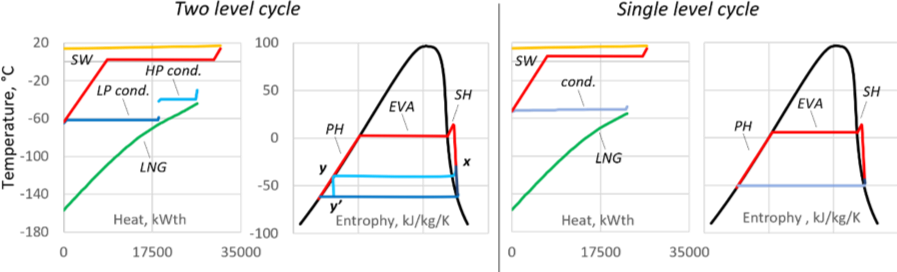
To address these limitations, Exergy International has developed and patented a multi-level condensation ORC for LNG applications. This is designed to maximise the use of the LNG heat sink along the vaporisation curve, thereby enhancing cycle efficiency and optimising electrical power at the required regasification rate. The patented design accommodates up to four levels of condensation, using a single feed pump in the ORC circuit and Exergy’s Radial Outflow Turbine (ROT). The benefits of this multi-level condensation system with a single feed pump include:
Higher efficiency and power production
The system achieves higher cycle efficiency, increased specific power production, and a greater cold energy recovery factor compared with single-level systems at the same regasification capacity, delivering up to +20% net power production.
Simplified pump configuration
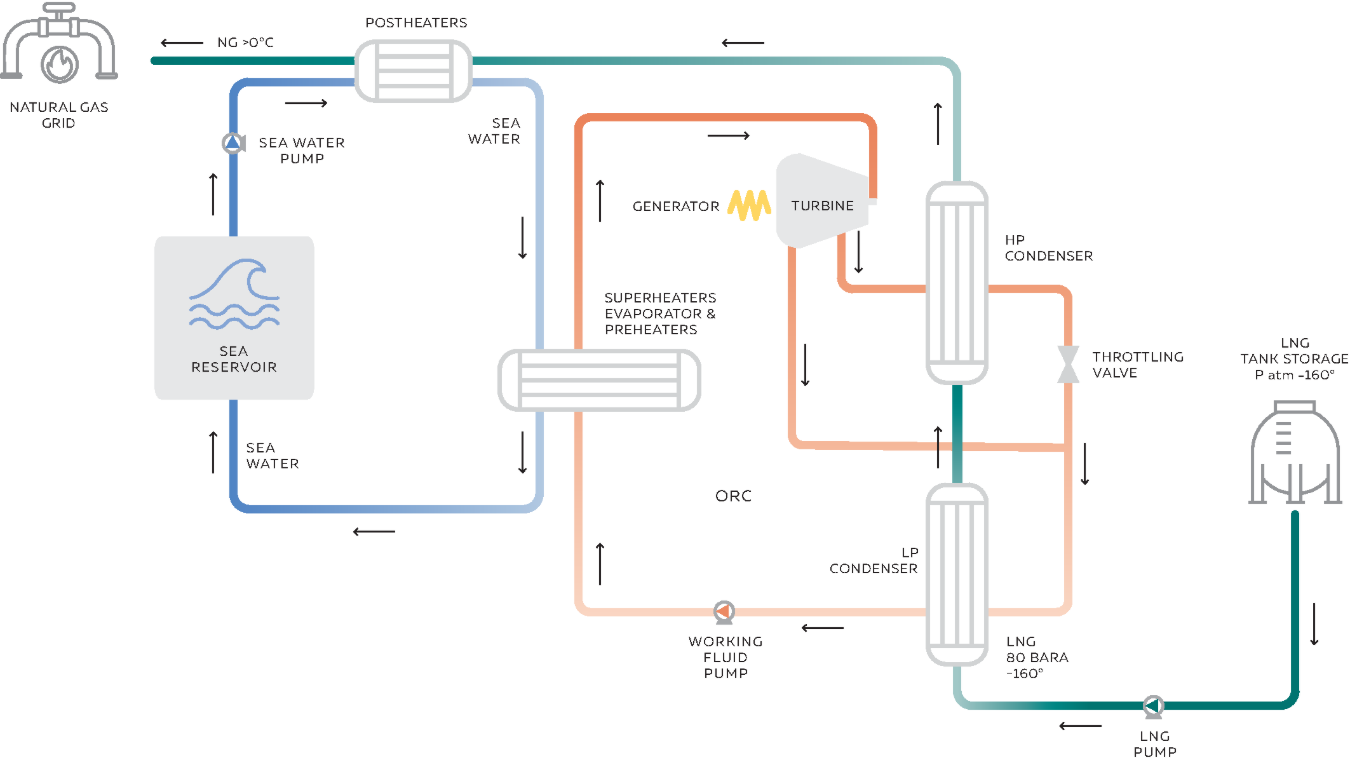
The system enables a single-pump configuration using a throttling valve at the outlet of the high-pressure condensers. At the valve outlet, the fluid undergoes depressurisation and enters a two-phase state, comprising liquid and vapour. This two-phase flow is directed to the lower-pressure condensers, where the liquid mixes with the low-pressure (LP) condensate and the vapour condenses together with the LP vapour from the turbine discharge. The use of a single, low suction pressure pump results in lower ORC plant complexity and CAPEX, fewer critical components exposed to cryogenic temperatures, an expected reduction in maintenance stops, and increased annual plant availability.
Integration with high-efficiency ROT
The configuration naturally facilitates spillages between stages, allowing both high-pressure (HP) and LP expansion within a single turbomachine unit.
Propane compatibility
The system is suitable for the use of propane as a working fluid, recognised as one of the best-performing hydrocarbons and widely available on the market at low cost. Propane has already demonstrated successful performance in conventional IFV and in numerous cryogenic applications. Additional advantages of propane include its low Global Warming Potential, below 10, and moderate vacuum capability in LP condensers, above 0.1 bar(a).
Additional advantages are specifically connected to the use of Exergy’s ROT:
The isentropic efficiency of the ROT is high in both on-design and off-design conditions, due to the optimisation of the velocity triangles, its multiple reaction and action stages, and the natural radial increase of the passage area, which allows expansion at a high volumetric flow ratio.
Unlike axial turbines, the ROT shaft length does not need to be increased to create clearance for spillage points. This avoids several rotor dynamic issues in an overhung configuration.
The low rotational speed of the ROT makes it possible to operate the direct drive without an additional gearbox.
Figure 2 illustrates the ORC plant with patented multiple condensation levels, configured with two condensation pressure levels. The key components of the ORC system include preheaters, an evaporator, and a superheater, which exchange heat with seawater, as well as the ROT turbine and generator. The system also includes HP and LP condensers responsible for heat exchange and LNG regasification, a single feed pump, and a condensate throttling valve at the outlet of the HP condenser on the ORC side. An LNG post-heater is incorporated to raise the LNG temperature from the outlet of the HP condenser using seawater, ensuring that the natural gas temperature remains above the minimum required by the gas distribution network.
Hybrid integration with existing open rack vaporiser systems
An additional deployment option for cold energy recovery is the integration of the ORC package with existing open rack vaporiser (ORV) systems. In this hybrid configuration, the ORC plant performs the initial stages of LNG vaporisation while recovering cold energy and generating electricity, whereas the existing ORV completes the final regasification step.
In practical terms, LNG can leave the ORC condensers and then be directed to the existing ORV, which operates at partial load to raise the gas temperature to the conditions required by the downstream gas network. As a result, the ORC package can recover a significant portion of the available cold energy while leveraging the existing terminal infrastructure.
This solution offers several advantages for terminal operators. Firstly, it minimises modifications to the regasification system by retaining the proven ORV technology already installed on site. Secondly, it reduces project complexity and facilitates retrofit applications where operators prefer a gradual introduction of new equipment. Finally, it provides an additional level of operational flexibility and security: in case the ORC package becomes unavailable for maintenance, the LNG flow can be fully diverted to the ORV system, allowing uninterrupted regasification and continuous terminal operation.
By combining power generation from cold energy recovery with the reliability of established regasification technologies, the hybrid ORC-ORV configuration provides a practical pathway for existing LNG terminals seeking to improve efficiency while maintaining operational resilience.
Case study
For a potential project at a South American LNG regasification terminal located in Chile, Exergy studied and designed an energy efficiency solution based on a cold energy plant using its patented multi-level condensation ORC cycle for cold energy recovery. LNG is the cooling source of the ORC plant. The LNG inlet conditions at the ORC cycle are as follows:
LNG flow: 150.5 tph.
LNG inlet temperature: -155˚C.
LNG inlet pressure: 60 barg.
After regasification takes place in the ORC cycle, the natural gas design outlet conditions at the ORC plant are:
Minimum natural gas return temperature: >3˚C.
Maximum natural gas pressure drop within ORC plant limits: 1 bar.
The seawater condition at ORC plant limits are:
Seawater flow: 5600 m3/h.
Seawater inlet temperature: 13˚C.
Seawater inlet pressure: 6.5 barg.
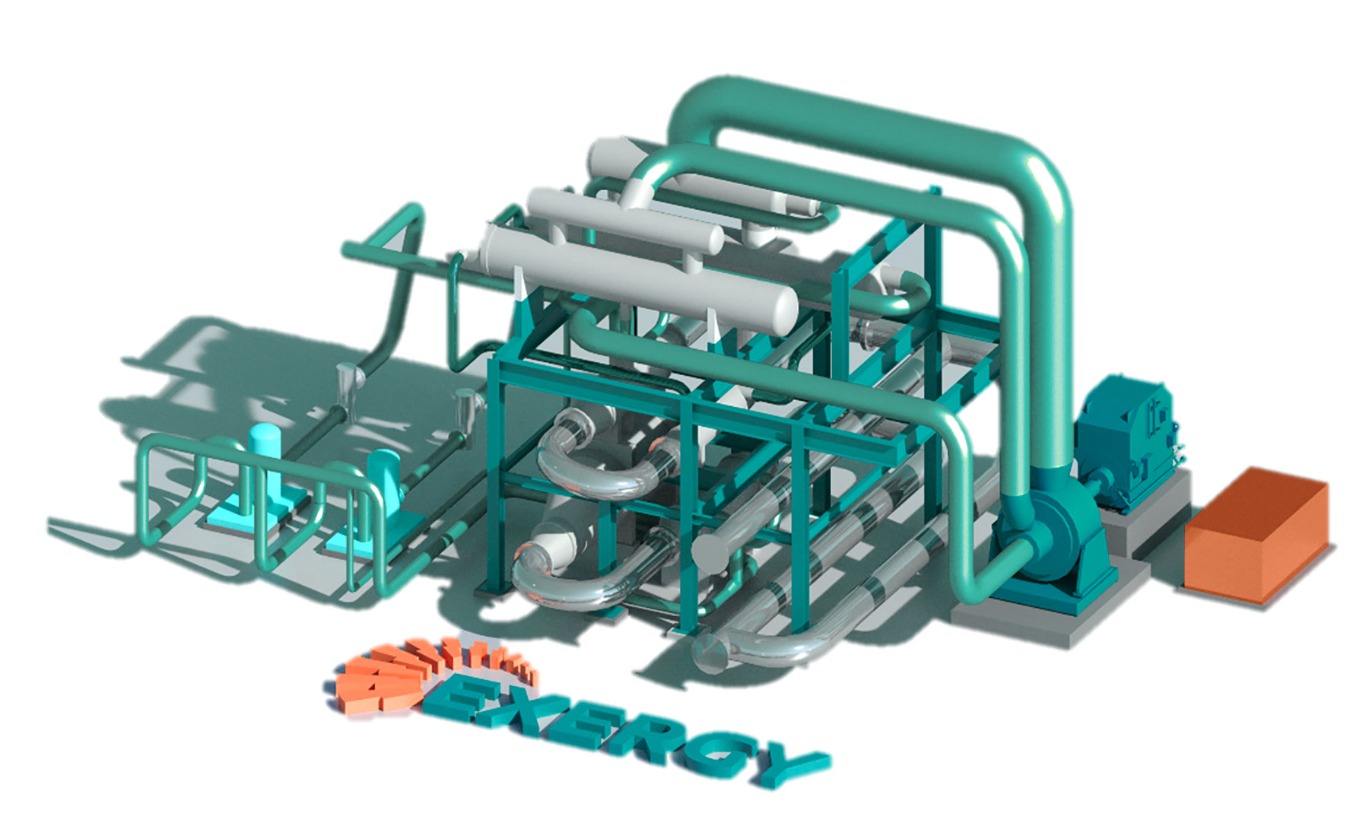
With the specified technical resource conditions, the cold energy plant designed by Exergy, using propane as the working fluid, could generate a net power output of 3.7 MWe. The installation was planned as an upgrade of an existing LNG terminal and aimed to replace ORV technology with ORC, enabling electricity production while regasifying natural gas. The ORC plant area, excluding the access and maintenance area, auxiliary systems, and control room, has a footprint of 30 m x 25 m x 5.8 m (W x L x H).
Environmental and operational benefits
The proposed cold energy plant would deliver both environmental and operational benefits for the LNG terminal. From an environmental perspective, the main advantage lies in the recovery of energy that would otherwise be discharged during the regasification process. By converting this unused cold energy into electricity, the plant can reduce the terminal’s reliance on externally supplied power and lower the indirect carbon dioxide emissions associated with its operation.
From an operational standpoint, this solution also improves the overall energy efficiency of the infrastructure, offering a practical route to upgrade existing regasification assets without altering their primary function. The ORC plant is designed to operate in parallel with the LNG vaporisation process, producing electricity while ensuring that natural gas is delivered at the required temperature and pressure conditions for the downstream gas network. The compact footprint of the plant also supports its integration into existing terminal layouts, making the solution suitable for retrofit applications where available space and operational continuity are critical factors.
In addition, replacing or integrating conventional ORVs with an ORC-based cold energy plant can help improve the terminal’s energy balance and create a new source of self-generated electricity. This power can be used to cover part of the terminal’s internal consumption, with potential surplus exported to the grid depending on local regulatory and grid-connection conditions. In this way, cold energy recovery transforms the regasification process from a purely energy-consuming operation into a more efficient process capable of generating additional value.
Conclusions
As LNG regasification capacity continues to expand across both established and emerging markets, the industry faces the challenge of combining infrastructure growth with higher efficiency and lower environmental impact. New terminals and capacity additions will play an important role in strengthening energy security and diversifying gas supply routes, but long-term competitiveness will increasingly depend on the ability to optimise existing processes. Cold energy recovery represents one of the opportunities in this direction which does not change the strategic role of LNG infrastructure, but it can make it more efficient, more resilient, and better aligned with the energy transition. For existing and future LNG terminals, this represents a concrete opportunity to extract additional value from the regasification process while contributing to a more sustainable use of energy resources.
Bibliography
‘2026 World LNG Report’, International Gas Union, (7 July 2026), www.igu.org/igu-reports/2026-world-lng-report
MARCHIORI, G., GIUDICI, M., RUFFATO, G., and ASTOLFI, M., ‘Cold energy recovery in LNG plants with Organic Rankine Cycle’, Proceedings of the 7th International Seminar on ORC Power System, (January 2024), pp. 626 – 635, https://doi.org/10.12795/9788447227457_109