As LNG producers face mounting pressure to improve uptime, reduce energy consumption, and control operating costs, maintenance strategies are evolving beyond traditional predictive approaches. Discover how Honeywell Technologies asset performance management empowers LNG facilities with near real-time asset intelligence, process enhancement, and enterprise-wide reliability to accelerate the journey toward autonomous operations.

The LNG industry is entering a new era of operational excellence. As global demand increases and market competitiveness intensifies, LNG operators are challenged to improve asset availability, improve production efficiency, reduce energy consumption, and reduce maintenance costs. Traditional maintenance approaches, even predictive maintenance programmes, are no longer enough to meet the performance expectations of modern LNG facilities. The future lies in autonomous operations powered by advanced asset intelligence and closed-loop improvement.
For decades, maintenance strategies have evolved from reactive maintenance, where equipment is repaired after failure, to preventive maintenance based on fixed schedules. More recently, predictive maintenance has enabled operators to identify equipment degradation before failures occur using condition monitoring and analytics. While this represented a significant step forward, predictive maintenance alone often leaves a gap between detecting a problem and implementing enhanced corrective action.
Today, leading LNG operators are closing that gap by leveraging Honeywell’s technologies such as asset performance management (APM), advanced process control (APC), and digital twins to create an intelligent, connected operating environment. These technologies move organisations beyond simply predicting failures toward continuously increasing asset performance and operational efficiency across entire LNG value chains.
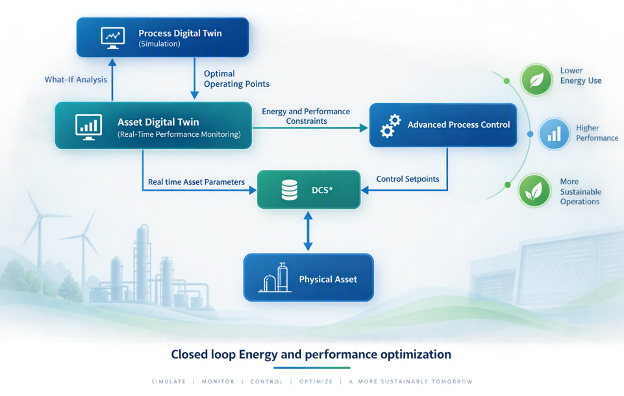
At the heart of LNG production are critical rotating assets, including refrigerant compressors, gas turbines, pumps, and refrigeration trains. Even minor efficiency losses in these systems can significantly increase energy consumption and operating costs. Honeywell Technologies APM helps provide near real-time visibility into asset health by utilising first-principles performance models and operational data to compare actual performance against expected design conditions. This allows operators to identify performance degradation, quantify efficiency losses, and determine the root causes before failures impact production.
For compressor and refrigeration train operations, the benefits are particularly significant. LNG liquefaction is one of the most energy-intensive processes in the hydrocarbon industry. Small deviations in compressor efficiency, suction and discharge pressure losses, recycle valve performance, or turbine operation can result in substantial increases in power consumption. By continuously monitoring key performance indicators such as efficiency, capacity loss, power utilisation, and operating margins, operators gain actionable insights that enable early intervention and performance enhancement.
However, visibility alone does not deliver maximum value. The next stage of operational maturity occurs when asset insights are integrated directly into process improvement workflows. Honeywell's APM platform can help provide near real-time performance and energy constraints to APC systems, allowing process variables and control setpoints to be adjusted automatically. Rather than relying on manual analysis and operator intervention, decisions can be applied consistently and continuously across LNG trains, allowing equipment to operate efficiently while maintaining production targets.
The integration of digital twin technology further accelerates this transformation. Process digital twins enable engineers to evaluate ‘what-if’ operating scenarios, validate recommended actions, and understand the production impact before changes are implemented. This is aimed to reduce operational risk while building confidence in enhancement recommendations. Engineers can rapidly identify the most efficient operating points for compressors, turbines, heat exchangers, and refrigeration systems, allowing energy and production objectives to remain aligned.
Beyond individual equipment improvement, enterprise-wide reliability programmes are becoming a strategic priority for LNG operators. Honeywell's asset-centric approach enables organisations to standardise performance monitoring, maintenance practices, and reliability metrics across multiple facilities. By aggregating asset performance data at the enterprise level, decision-makers can help benchmark operations, identify recurring performance issues, prioritise maintenance investments, and replicate best practices throughout their organisations.
The result is a significant shift from isolated maintenance activities toward holistic operational performance management. Facilities can reduce unplanned downtime, extend equipment life, decrease maintenance expenditures, increase throughput, and lower greenhouse gas emissions simultaneously. More importantly, organisations gain the operational consistency and intelligence required to support increasingly autonomous facilities.
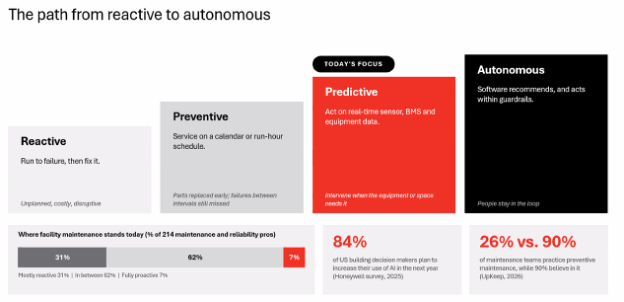
As LNG operations continue to digitalise, autonomous performance will become the new benchmark for competitiveness. The convergence of APM, APC, and digital twin technologies is creating self-improving environments where assets not only communicate their health, but also actively influence operating decisions.
For LNG operators seeking to improve reliability while reducing operating costs and environmental impact, the transition from predictive maintenance to autonomous operations is not simply a technology upgrade. It is a strategic transformation that unlocks new levels of efficiency, resilience, and business performance across the entire enterprise.
Explore solutions, insights, and technologies shaping the next generation of LNG operations: Towards the Autonomous LNG Plant.